AI risk assessment under EU law has become a defining task for compliance professionals across the continent. The EU AI Act, which entered into force in August 2024, establishes a risk-based framework that requires organizations to classify, evaluate, and mitigate risks associated with their AI systems before deployment.
For AI compliance officers, this isn't a theoretical exercise; it's a structured, documented process with real regulatory consequences. Failure to properly assess risk can lead to fines of up to 35 million euros or 7% of global annual turnover. This guide walks you through the practical steps of conducting an AI risk assessment that satisfies EU AI Act compliance requirements.
Whether you're working with a single high-risk system or managing a portfolio of AI applications, these steps will give you a concrete roadmap. Understanding the full scope of EU AI Act compliance obligations is the essential starting point for any risk assessment effort.
Key Takeaways
- Map every AI system in your organization before starting any risk classification work.
- The EU AI Act defines four risk tiers: unacceptable, high, limited, and minimal risk.
- High-risk systems require conformity assessments, technical documentation, and human oversight mechanisms.
- Document your risk assessment methodology thoroughly; regulators will request evidence of process.
- Reassess risk continuously, not just once, as AI systems evolve through retraining and updates.
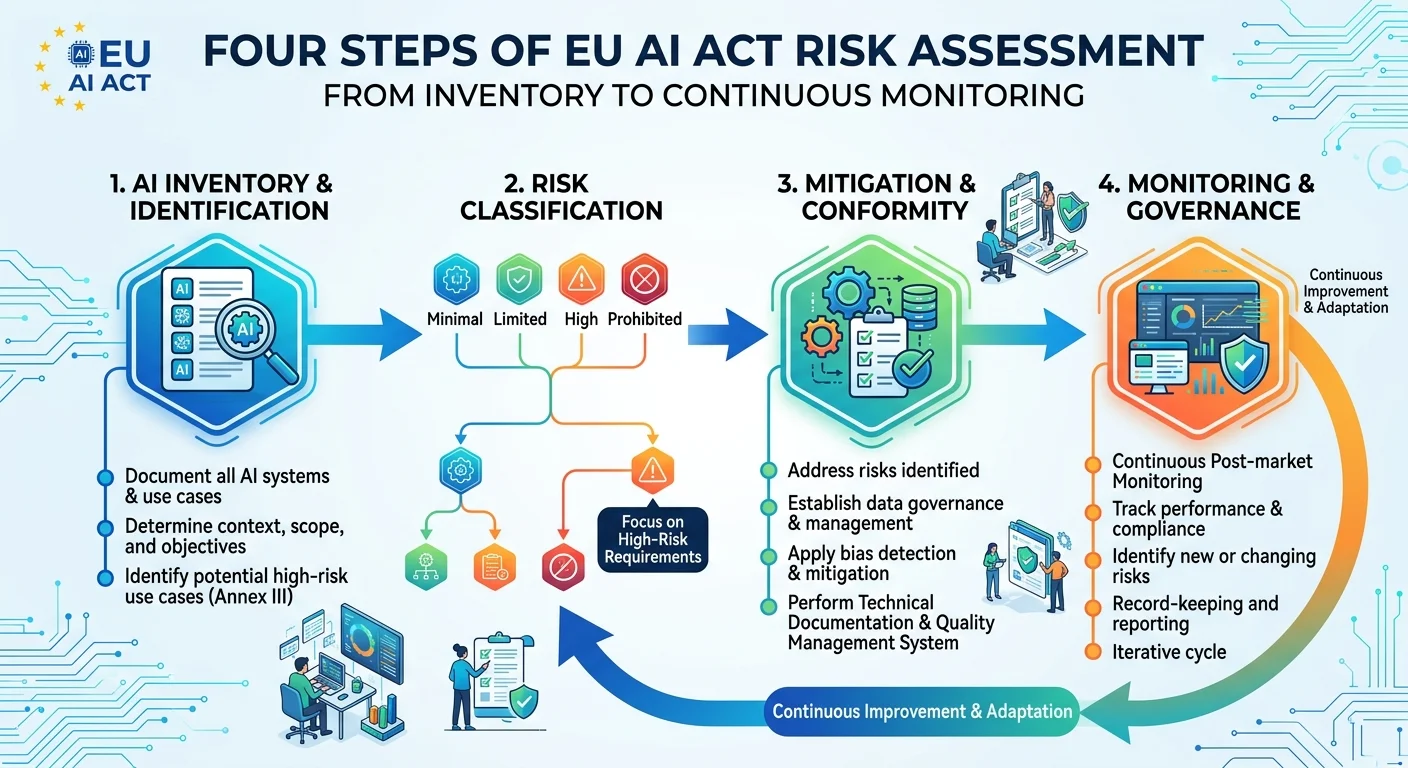
Step 1: Inventory and Map Your AI Systems
Building a Comprehensive AI Register
Before you can assess risk, you need to know exactly what you're assessing. Many organizations discover that AI systems have proliferated far beyond what central teams are aware of. Start by conducting a thorough inventory that covers every AI system in production, in development, and in procurement pipelines. This includes third-party AI tools embedded in SaaS platforms, vendor-provided models, and internally developed machine learning applications. Your register should capture the system name, purpose, data inputs, outputs, deployment context, and the business unit responsible.
A practical approach is to issue a structured questionnaire to every department head, asking them to identify any automated decision-making tools, predictive analytics, natural language processing systems, or computer vision applications in use. Don't rely solely on IT records. Marketing teams often adopt AI-powered tools independently, and HR departments may use resume screening software without formal procurement. Cast the net wide. Each entry in your register should be detailed enough that someone unfamiliar with the system could understand its function and scope.
Use a standardized template for your AI register that maps directly to the information requirements in Article 11 of the EU AI Act.
Identifying System Owners and Stakeholders
Every AI system needs a clearly designated owner who holds accountability for its compliance status. This person should be someone with sufficient authority to make decisions about the system's design, deployment, and decommissioning. In practice, this is often a product manager or engineering lead, not a data scientist. Alongside the system owner, identify key stakeholders: the data protection officer, legal counsel, affected business users, and any external vendors who supply components of the system.
Document the governance chain for each system. Who approved its deployment? Who reviews its performance? Who has the authority to shut it down if risks materialize? These questions matter because AI regulation under the EU AI Act places specific obligations on "providers" and "deployers," and your internal governance structure must reflect these roles. Getting this mapping right at the outset prevents confusion later when regulators ask who is responsible for a particular system's compliance.
Step 2: Classify Risk Levels Under the EU AI Act
Understanding the Four Risk Tiers
The EU AI Act organizes AI systems into four risk categories, and proper classification is the backbone of your entire AI risk assessment. Unacceptable risk covers systems that are outright prohibited, such as social scoring by governments, real-time remote biometric identification in public spaces (with narrow exceptions), and manipulative AI that exploits vulnerabilities. High-risk systems are those listed in Annex III or used as safety components of products covered by existing EU harmonization legislation. Limited-risk systems carry transparency obligations, while minimal-risk systems face no specific regulatory requirements.
The classification decision is not always straightforward. A chatbot used for customer service inquiries about product returns is likely minimal risk. But the same chatbot technology, if deployed by a public authority to handle asylum applications, could fall into the high-risk category. Context matters enormously. You must evaluate each system against the specific use cases enumerated in Annex III, not just the underlying technology. An AI model is not inherently high-risk or low-risk; its classification depends on its application.
| Risk Level | Examples | Key Obligations | Timeline |
|---|---|---|---|
| Unacceptable | Social scoring, manipulative AI | Prohibited entirely | February 2025 |
| High | Biometric ID, credit scoring, recruitment AI | Conformity assessment, documentation, monitoring | August 2026 |
| Limited | Chatbots, emotion recognition | Transparency obligations | August 2026 |
| Minimal | Spam filters, AI-enabled games | None (voluntary codes of conduct) | N/A |
Applying Annex III Criteria
Annex III of the EU AI Act lists eight specific areas where AI systems are considered high-risk. These include biometric identification, management of critical infrastructure, education and vocational training, employment and worker management, access to essential services (including credit scoring), law enforcement, migration and asylum, and administration of justice. For each AI system in your inventory, systematically check whether its intended purpose falls within any of these areas. If it does, the full suite of high-risk obligations applies.
Misclassifying a high-risk system as limited or minimal risk can result in fines up to 15 million euros or 3% of global turnover.
Pay close attention to edge cases. An AI system that recommends training courses to employees might seem innocuous, but if it materially affects career progression or access to employment, it could qualify under the employment category. When in doubt, classify upward. The cost of over-compliance is far lower than the regulatory and reputational cost of under-classification. Engage legal counsel experienced in AI governance best practices to validate borderline classifications.
"Context determines risk classification, not the technology itself. The same AI model can be minimal risk in one application and high-risk in another."
Step 3: Perform Detailed Risk Analysis and Mitigation
Conducting Impact Assessments
For every system classified as high-risk, you must conduct a thorough impact assessment. This goes beyond a simple checklist. You need to evaluate the potential harm to individuals' fundamental rights, including privacy, non-discrimination, freedom of expression, and human dignity. Consider both the probability and severity of potential harm. A system that occasionally misclassifies low-priority support tickets is different from one that incorrectly denies someone access to financial services. Quantify risks where possible, and describe them qualitatively where quantification isn't feasible.
Your impact assessment should also examine data quality and representativeness. Biased training data is one of the most common sources of AI risk. If your credit scoring model was trained predominantly on data from one demographic group, its predictions for other groups may be unreliable or discriminatory. Assess whether your training datasets reflect the diversity of the population the system will serve. Document any gaps you identify and the steps you plan to take to address them. This analysis is not optional for high-risk systems; Article 10 explicitly mandates data governance standards.
Designing Mitigation Measures
Once you've identified risks, you need concrete mitigation strategies. The EU AI Act requires high-risk systems to incorporate human oversight mechanisms, meaning a qualified person must be able to understand, monitor, and override the system's outputs. This isn't a rubber-stamp review; the human overseer must have genuine authority and sufficient information to intervene meaningfully. Design your systems so that automated decisions can be paused, reversed, or escalated to human judgment at any point.
Technical mitigation measures should address accuracy, robustness, and cybersecurity. Implement testing protocols that evaluate system performance across different demographic groups and edge cases. Establish thresholds for acceptable error rates and define clear escalation procedures when those thresholds are breached. For AI systems that interact with the public, build in transparency features: inform users that they are interacting with AI, explain the basis for automated decisions, and provide clear channels for contesting those decisions. Each mitigation measure should be traceable back to a specific identified risk in your assessment.
Mitigation measures for general-purpose AI models (like foundation models) follow separate rules under Article 53, with additional obligations for models posing systemic risks.
Step 4: Document, Monitor, and Maintain Compliance
Building Your Compliance Documentation Package
Documentation is not a byproduct of compliance; it is compliance. The EU AI Act requires providers of high-risk AI systems to maintain comprehensive technical documentation before the system is placed on the market. This documentation must describe the system's intended purpose, its architecture, the training and validation data used, performance metrics, and the risk management measures implemented. It must be detailed enough for a national competent authority to assess whether the system meets the requirements of the regulation.
Structure your documentation package to mirror the requirements in Annex IV of the Act. Include a general description, a detailed account of your risk management system, descriptions of data governance practices, technical specifications for accuracy and robustness testing, and records of human oversight arrangements. Keep version-controlled records so you can demonstrate the state of the system at any point in time. If your system undergoes significant modifications, the documentation must be updated and the AI risk assessment repeated. Treat documentation as a living artifact, not a one-time deliverable.
Create a documentation template aligned with Annex IV early. Retrofitting documentation after development is far more expensive than building it in from the start.
Continuous Monitoring and Reassessment
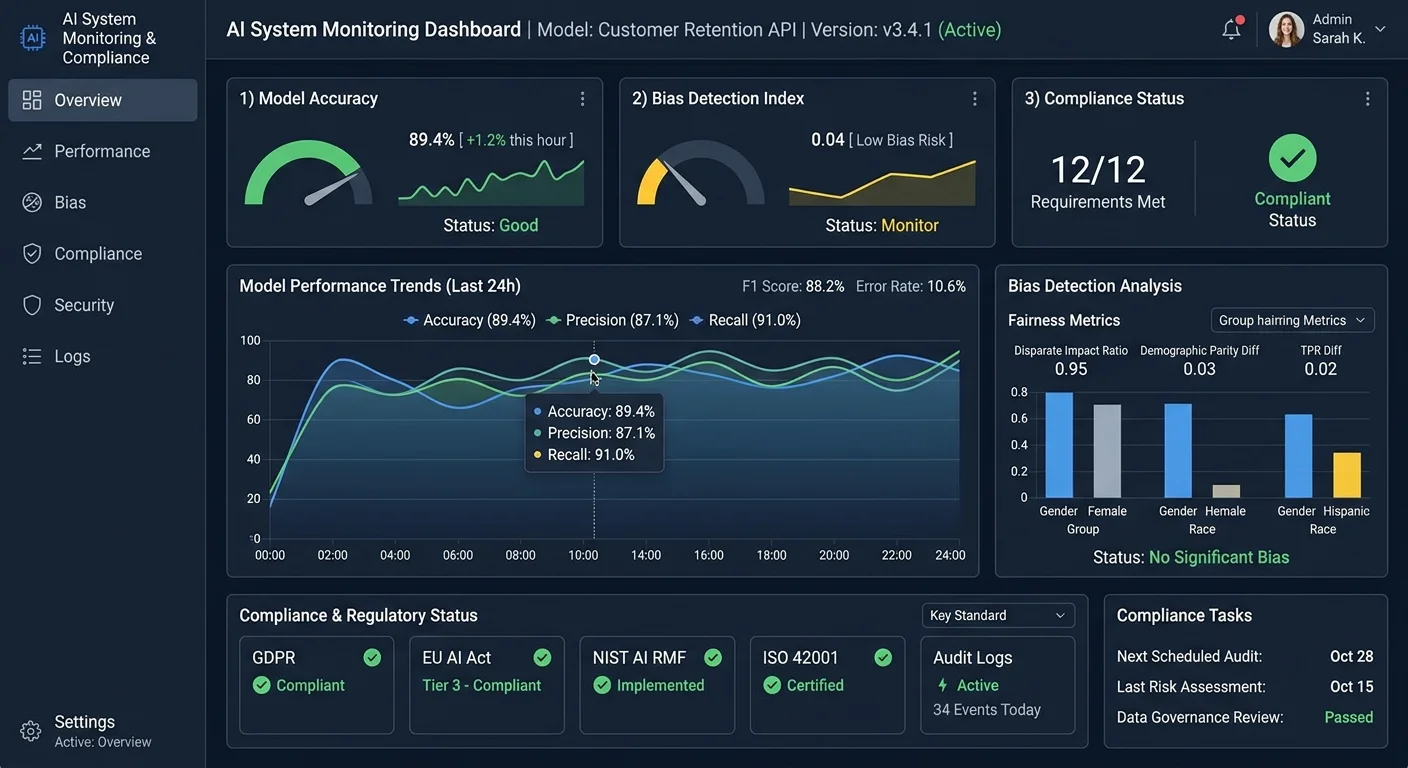
The EU AI Act explicitly requires post-market monitoring for high-risk AI systems. This means your risk assessment doesn't end at deployment. You need ongoing processes to detect performance degradation, emerging biases, or shifts in the system's operating environment that might change its risk profile. Set up automated monitoring dashboards that track key performance indicators, error rates, and user complaints. Review these metrics at defined intervals, monthly at minimum for high-risk systems, and document your findings.
Reassessment triggers should be clearly defined. Any significant update to the model, such as retraining on new data, architecture changes, or expansion into new use cases, should prompt a fresh review of the risk classification and mitigation measures. Similarly, external changes like new regulatory guidance from the AI Office or relevant court decisions should trigger a review. Build these triggers into your compliance management workflows. AI regulation under the EU AI Act is not a point-in-time exercise; it's an ongoing operational commitment that requires dedicated resources and sustained attention from compliance teams.
Frequently Asked Questions
?How do you apply Annex III criteria to classify an AI system?
?Can third-party SaaS AI tools trigger EU AI Act compliance obligations?
?How long does a full EU AI Act risk assessment typically take?
?Is a one-time risk assessment enough to stay compliant under the EU AI Act?
Final Thoughts
Conducting an AI risk assessment under EU law is a structured, repeatable process, not a mysterious art. The four steps outlined here, inventory, classification, risk analysis, and documentation with monitoring, form the operational backbone of EU AI Act compliance.
Start with what you have, improve iteratively, and resist the temptation to treat this as a one-time project. The organizations that will navigate AI regulation most effectively are those that embed risk assessment into their standard development and procurement workflows today.
Disclaimer: Portions of this content may have been generated using AI tools to enhance clarity and brevity. While reviewed by a human, independent verification is encouraged.