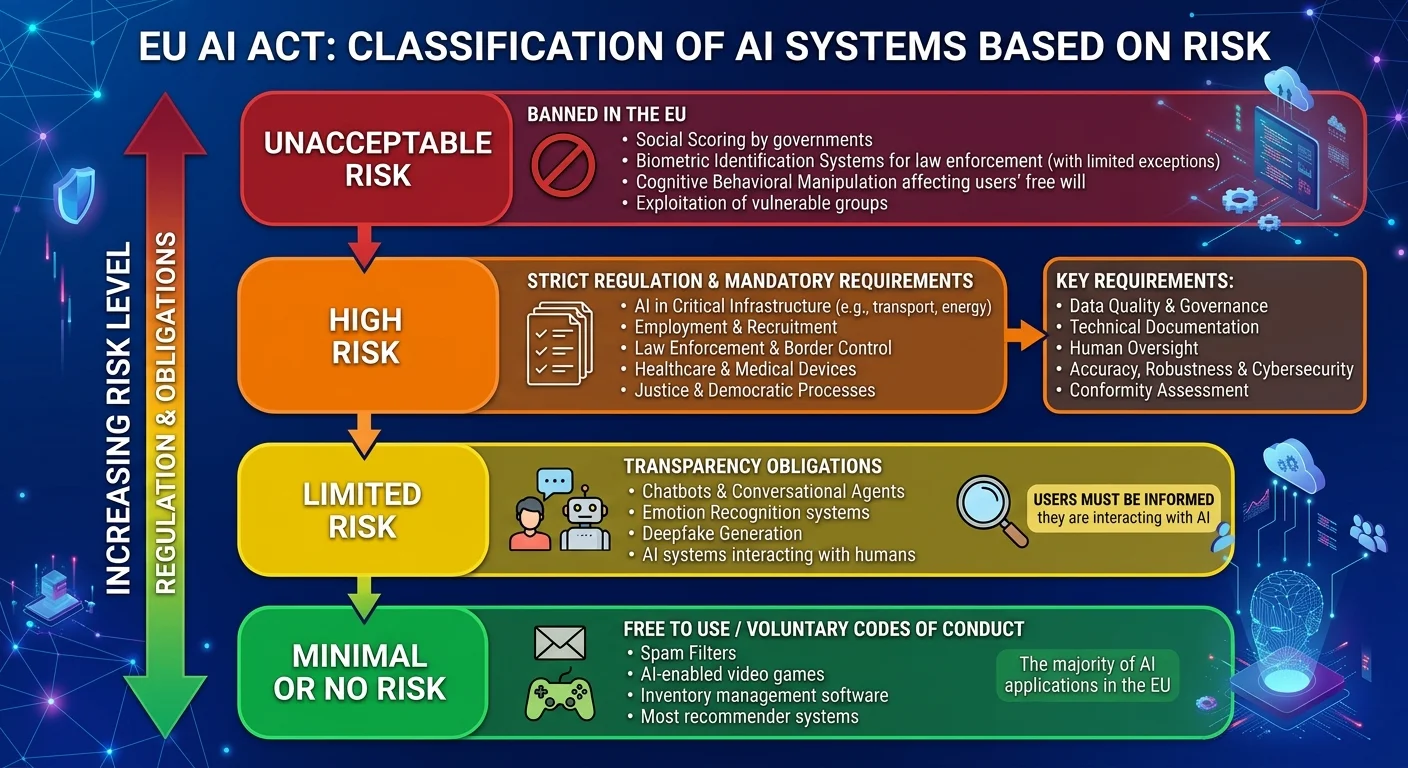
EU AI Act compliance is no longer a future concern; it's a present-day operational requirement for organizations deploying artificial intelligence across Europe. The regulation introduces a risk-based framework that sorts AI systems into categories ranging from minimal to unacceptable risk.
The high-risk category is where most compliance officers will spend their time, because it carries the heaviest obligations and the steepest penalties for noncompliance. Fines can reach up to 35 million euros or 7% of global annual turnover, whichever is higher. Understanding what qualifies as a high-risk AI system, and what your organization must do about it, is the foundation of any serious AI regulation strategy. This guide breaks down the process into four practical steps.
If you're responsible for AI risk assessment at your company, this article will give you a clear, actionable path forward. For a broader overview of the regulation's full scope, our complete guide to EU AI Act compliance covers every tier in detail.
Key Takeaways
- High-risk AI systems face the strictest requirements under the EU AI Act's risk framework.
- Annex III lists eight specific areas where AI systems automatically qualify as high-risk.
- Conformity assessments require technical documentation, human oversight, and ongoing monitoring plans.
- Non-compliance penalties can reach 35 million euros or 7% of global annual turnover.
- Start your gap analysis now because enforcement timelines are already active for some provisions.
Step 1: Identify Whether Your AI System Qualifies as High-Risk
The EU AI Act defines high-risk AI systems through two primary mechanisms. First, Annex II covers AI systems that serve as safety components of products already regulated under existing EU product safety legislation, such as medical devices, machinery, and vehicles. Second, Annex III explicitly lists standalone AI systems in eight domains that the European Commission considers inherently risky. If your system falls into either bucket, you're subject to the full suite of high-risk obligations.
The distinction matters because many compliance officers initially overlook the Annex II pathway. If your AI system is embedded within a product that already requires a CE marking, the AI component inherits high-risk classification automatically. Think of an AI-powered diagnostic module inside a medical device or an automated braking system in a vehicle. These don't need a separate high-risk determination; the product category settles the question.
Annex III: The Eight High-Risk Domains
Annex III is where most standalone AI systems get classified. The eight areas include biometric identification, critical infrastructure management, education and vocational training, employment and worker management, access to essential services (credit scoring, for example), law enforcement, migration and asylum management, and administration of justice. If your AI system makes or materially influences decisions in any of these areas, it qualifies as high-risk under the regulation's explicit terms.
One important nuance: the Act includes an exception in Article 6(3). If an AI system in an Annex III area performs a narrow procedural task, prepares an assessment that a human will fully review, or detects decision-making patterns without replacing human judgment, it may be exempted from high-risk classification. However, you must document this reasoning carefully. Regulators will expect a written justification, not an informal assumption that you're exempt. Keep a record of your classification rationale from the very beginning of your assessment process.
Create a classification register for every AI system your organization operates, documenting why each system is or isn't classified as high-risk.
Step 2: Map Your Obligations Under the AI Regulation Framework
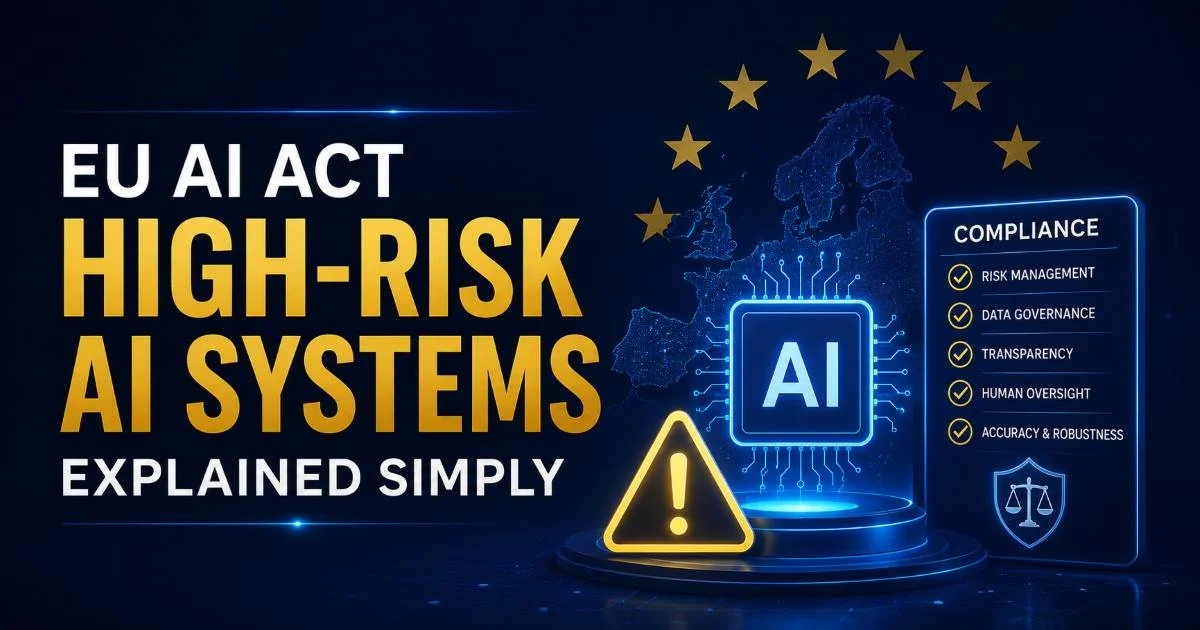
Once you've confirmed a system is high-risk, the next step is mapping every compliance obligation it triggers. The EU AI Act imposes requirements across several operational dimensions: risk management, data governance, technical documentation, transparency, human oversight, accuracy, robustness, and cybersecurity. Each of these isn't a checkbox exercise. The regulation expects ongoing, demonstrable compliance that evolves with your system over its full lifecycle.
The Core Compliance Requirements
Article 9 mandates a risk management system that operates continuously, not just at deployment. You need to identify foreseeable risks, estimate their likelihood and severity, adopt mitigation measures, and test those measures against real-world conditions. Article 10 addresses training data quality, requiring that datasets be relevant, representative, and as free from bias as reasonably achievable. These aren't aspirational guidelines. They're legal requirements with enforcement mechanisms behind them.
| Obligation | EU AI Act Article | What It Requires |
|---|---|---|
| Risk Management System | Article 9 | Continuous identification, analysis, and mitigation of risks |
| Data Governance | Article 10 | Representative, bias-checked training and validation datasets |
| Technical Documentation | Article 11 | Detailed system description, design choices, and performance metrics |
| Record-Keeping | Article 12 | Automatic logging of system operations for traceability |
| Transparency | Article 13 | Clear instructions for deployers on system capabilities and limits |
| Human Oversight | Article 14 | Design features enabling human intervention and override |
| Accuracy and Robustness | Article 15 | Consistent performance levels appropriate to the system's purpose |
Technical documentation under Article 11 goes far beyond a simple user manual. You need to describe the system's intended purpose, its algorithmic logic, training methodology, validation results, and known limitations. This documentation must be available to national authorities on request. Article 14's human oversight requirement means your system needs a concrete mechanism for a human operator to intervene, override, or shut down the system when necessary. Think of it as a mandatory "off switch" with clear accountability assigned to a specific role.
Deployers of high-risk AI systems have their own separate set of obligations under Articles 26 and 27, distinct from provider obligations.
Articles 12 and 13 work together to create an audit trail. Your system must automatically log its operations at a level of detail that allows post-hoc review. Meanwhile, transparency provisions require you to provide deployers with enough information to understand the system's behavior, interpret its outputs, and use it appropriately. For organizations seeking structured approaches to managing this documentation, tools like context protocols can help standardize how technical information is organized and shared across teams.
Step 3: Conduct a Thorough AI Risk Assessment
With your obligations mapped, you need a structured AI risk assessment process. This isn't a one-time audit. The EU AI Act expects risk management to be embedded in your development and deployment workflows as a continuous discipline. Start by assembling a cross-functional team that includes data scientists, legal counsel, domain experts, and operational stakeholders. Each group brings a perspective that the others will miss when evaluating potential harms.
"Risk assessment under the EU AI Act is a continuous discipline, not a one-time audit before deployment."
Building the Risk Assessment Workflow
Your assessment should follow a four-phase cycle: identification, analysis, evaluation, and treatment. During identification, catalog every foreseeable risk your system could pose to health, safety, or fundamental rights. Be specific. "Bias" is not a risk; "systematic underscoring of loan applications from applicants in specific postal codes due to biased training data" is a risk. Analysis quantifies each risk's probability and impact. Use concrete metrics where possible, drawing on testing data, pilot outcomes, and comparable systems.
Evaluation is where you compare each risk against your organization's risk tolerance and the Act's requirements. Some risks can be mitigated through technical measures like retraining models or adding input validation. Others require procedural safeguards such as mandatory human review before a decision takes effect. Treatment is the implementation phase, where you document and deploy your chosen mitigations. Every treatment decision should reference a specific risk and explain why the chosen approach is proportionate.
Testing is where many organizations fall short. The Act expects you to validate your system against real-world conditions, not just controlled lab environments. Run adversarial tests, edge-case scenarios, and stress tests that reflect how your system will actually be used. Document everything: test methodology, results, and the actions you took based on findings. If a risk remains after mitigation but falls within acceptable thresholds, record that residual risk explicitly. Regulators will want to see that you made a conscious, documented decision rather than simply overlooking the issue.
Failing to document residual risks can be treated as noncompliance even if your system performs well in practice.
Step 4: Prepare for Conformity Assessment and Registration
Before placing a high-risk AI system on the EU market or putting it into service, you must complete a conformity assessment. This process verifies that your system meets all applicable requirements under the Act. For most high-risk systems listed in Annex III, providers can conduct an internal conformity assessment, meaning you evaluate your own compliance using the procedures laid out in Annex VI. However, certain categories, particularly remote biometric identification systems used by law enforcement, require assessment by a notified body.
Internal vs. Third-Party Conformity Assessment
For internal assessments, you need a quality management system (QMS) that covers your AI development lifecycle from design through post-market monitoring. This QMS must address resource allocation, accountability structures, design controls, data management, and complaint handling. It's essentially the backbone of your EU AI Act compliance program. Write it down, assign ownership, and review it at least annually. National market surveillance authorities can request your QMS documentation at any time.
After completing the conformity assessment, you must register the system in the EU database for high-risk AI systems before placing it on the market. Registration requires providing your organization's details, the system's intended purpose, its conformity status, and relevant contact information. This database is publicly accessible for most entries, which means your registration also serves as a transparency mechanism. Incomplete or inaccurate registration can itself trigger enforcement action, so treat it as a formal regulatory filing rather than an administrative checkbox.
Start your EU database registration preparation early, as gathering the required technical details typically takes four to six weeks for complex systems.
Post-market monitoring is the final, ongoing piece of the puzzle. Article 72 requires providers of high-risk systems to establish a monitoring system proportionate to the nature and risks of the AI technology. This means collecting and analyzing performance data throughout the system's operational life, reporting serious incidents to authorities within prescribed timelines, and updating your risk management documentation as new information emerges. AI compliance is not a project with a finish line. It's an operational capability your organization must sustain indefinitely.
Frequently Asked Questions
?How do I document the Article 6(3) exemption for my AI system?
?Does an AI system embedded in a CE-marked product need a separate high-risk review?
?How long does a conformity assessment typically take to complete?
?Can a credit scoring AI avoid high-risk classification under Annex III?
Final Thoughts
High-risk AI systems under the EU AI Act demand serious, sustained attention from compliance teams. The obligations are detailed, the timelines are concrete, and the penalties for getting it wrong are substantial.
Start with classification, map your obligations systematically, build a living risk assessment process, and prepare your conformity documentation well before market entry. Organizations that treat this as an ongoing operational discipline rather than a one-time project will be best positioned when enforcement ramps up across EU member states.
Disclaimer: Portions of this content may have been generated using AI tools to enhance clarity and brevity. While reviewed by a human, independent verification is encouraged.