EU AI Act compliance is the structured process of aligning your artificial intelligence systems with the European Union's Artificial Intelligence Act, a regulation that establishes risk-based requirements for AI developers, deployers, and distributors operating within the EU. For AI compliance officers, this isn't a distant regulatory concept anymore.
The Act entered into force in August 2024, and enforcement timelines are already ticking. Organizations that fail to classify their AI systems properly, assess risks, and close regulatory gaps face fines of up to €35 million or 7% of global annual turnover, whichever is higher. The stakes are concrete, immediate, and financial. This article breaks down what EU AI Act compliance actually means, how it works in practice, and why getting ahead of it now will save your organization significant pain later.
Key Takeaways
- EU AI Act compliance requires classifying every AI system by its risk level.
- Prohibited AI practices must be eliminated before February 2025 enforcement begins.
- High-risk systems carry the heaviest documentation and transparency obligations.
- An artificial intelligence compliance checklist accelerates gap identification and remediation planning.
- Early ai risk assessment protects organizations from steep financial penalties and reputational damage.
How EU AI Act Compliance Works
The Risk Classification Framework
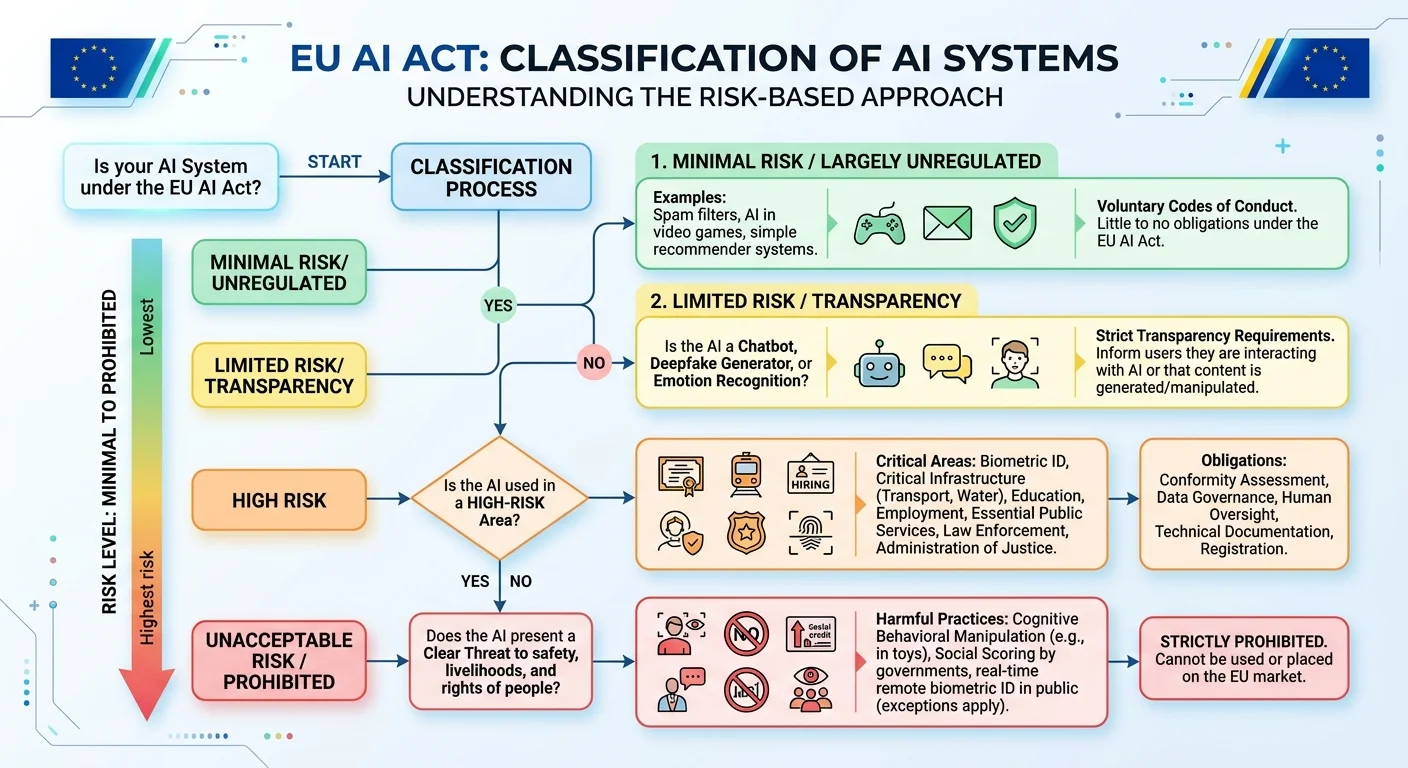
At its core, the EU AI Act operates on a tiered risk model. Every AI system gets classified into one of four categories: unacceptable risk, high risk, limited risk, or minimal risk. Unacceptable-risk systems (such as social scoring by governments or real-time biometric identification in public spaces for law enforcement, with narrow exceptions) are banned outright. High-risk systems face the most demanding requirements, including conformity assessments, technical documentation, and human oversight provisions.
AI system classification is not optional or informal. It requires a systematic evaluation of each system's intended purpose, the sector it operates in, and the potential harm it could cause. A recruitment AI that screens job applicants, for example, falls squarely into the high-risk category because it directly affects people's access to employment. A spam filter, by contrast, typically qualifies as minimal risk with virtually no specific obligations.
Limited-risk systems, like chatbots, primarily carry transparency obligations. Users must be informed they are interacting with an AI. Minimal-risk systems face no specific regulatory requirements, though voluntary codes of conduct are encouraged. Understanding where each of your systems falls is the first real step in any ai risk assessment, and getting it wrong can mean either over-investing in compliance for low-risk tools or, worse, under-preparing for high-risk ones.
Obligations by Role
The Act distinguishes between providers (those who develop or place AI systems on the market) and deployers (organizations that use AI systems within their operations). Providers of high-risk systems bear the heaviest burden: they must implement risk management systems, maintain quality datasets, produce technical documentation, and register their systems in an EU database. Deployers, meanwhile, must monitor systems in operation, maintain logs, and conduct data protection impact assessments where applicable.
Map every AI system in your organization to a specific role (provider or deployer) before beginning any compliance work.
| Risk Level | Example Systems | Key Obligations | Enforcement Start |
|---|---|---|---|
| Unacceptable | Social scoring, manipulative AI | Prohibited entirely | February 2025 |
| High | Hiring tools, credit scoring, medical devices | Conformity assessment, documentation, monitoring | August 2026 |
| Limited | Chatbots, emotion recognition | Transparency and disclosure | August 2026 |
| Minimal | Spam filters, AI-enabled games | None (voluntary codes encouraged) | N/A |
Why Compliance Matters Now
Enforcement Timeline Pressure
The EU AI Act did not arrive with a generous grace period for every provision. Prohibitions on unacceptable-risk AI practices took effect in February 2025. Requirements for general-purpose AI models follow in August 2025. The bulk of high-risk system obligations kick in by August 2026. This staggered timeline means compliance officers cannot treat the entire regulation as a single future deadline. Different parts of your AI portfolio face different deadlines right now.
Organizations that have not yet begun identifying ai regulatory gaps in their operations are already behind. A thorough inventory of all AI systems in use, combined with proper classification, can take months for large enterprises. Add remediation work, documentation creation, and staff training on top of that, and the calendar gets tight very quickly. Waiting until 2026 to address high-risk system requirements would be a serious strategic miscalculation.
Prohibited AI practices enforcement began February 2025. If your organization uses any banned system categories, you are already at risk of penalties.
Business and Market Impact
Beyond penalties, EU AI Act compliance carries significant market implications. Organizations demonstrating compliance gain a competitive edge when contracting with EU-based clients, governments, and regulated industries. Non-compliant vendors will increasingly find themselves excluded from procurement processes and partnership opportunities. The regulation functions as a market-shaping force, similar to how GDPR reshaped data handling practices globally.
There is also a reputational dimension. Public trust in AI is fragile, and organizations caught deploying prohibited or poorly governed AI systems face lasting brand damage. Proactive compliance signals to customers, regulators, and partners that your organization takes responsible AI seriously. This is especially relevant for companies building AI-powered consumer tools, where user trust directly impacts adoption and retention.
"Compliance is not just a legal obligation; it is becoming the price of admission to the EU's AI market."
Common Misconceptions and Pitfalls
Myth Versus Reality
One of the most persistent misconceptions is that the EU AI Act only applies to companies headquartered in Europe. In reality, the regulation applies to any organization that places AI systems on the EU market or whose AI system outputs are used within the EU. If your company is based in the United States but your AI-powered product serves European customers, you fall within scope. This extraterritorial reach mirrors GDPR's approach and catches many non-EU companies off guard.
Another common mistake is assuming that "low-risk" means "no obligations." While minimal-risk systems do not face specific regulatory requirements, the Act still encourages adherence to voluntary codes of conduct. More importantly, miscategorizing a high-risk system as minimal risk does not eliminate your obligations; it just means you have a compliance gap you haven't acknowledged. Proper ai system classification requires honest, documented analysis rather than wishful thinking about where your systems fall.
Classification is not a one-time exercise. Systems can shift risk categories if their intended use changes or if they are deployed in new contexts.
Some compliance officers also wrongly believe that existing frameworks like ISO 42001 or internal AI ethics boards fully satisfy the Act's requirements. While those efforts are valuable starting points, the EU AI Act imposes specific, legally binding technical and procedural requirements that go well beyond general principles. You need conformity assessments, detailed technical documentation in prescribed formats, and registration in the EU's public database for high-risk systems. Good intentions do not substitute for regulatory specifics.
A fourth misconception worth addressing: many teams assume compliance is purely a legal department responsibility. The reality is that EU AI Act compliance demands cross-functional coordination. Data scientists need to document training data. Engineers must build in human oversight mechanisms. Product managers need to assess intended use cases against risk categories. Treating compliance as a siloed legal exercise almost guarantees gaps in your implementation.
Practical Steps for Compliance Officers
Building Your Compliance Workflow
Start with a comprehensive AI inventory. You cannot classify what you have not catalogued. This means identifying every AI system your organization develops, deploys, or distributes, including third-party tools embedded in your workflows. For each system, document its purpose, the data it processes, who it affects, and where it operates geographically. This inventory forms the backbone of your artificial intelligence compliance checklist and feeds directly into your classification decisions.
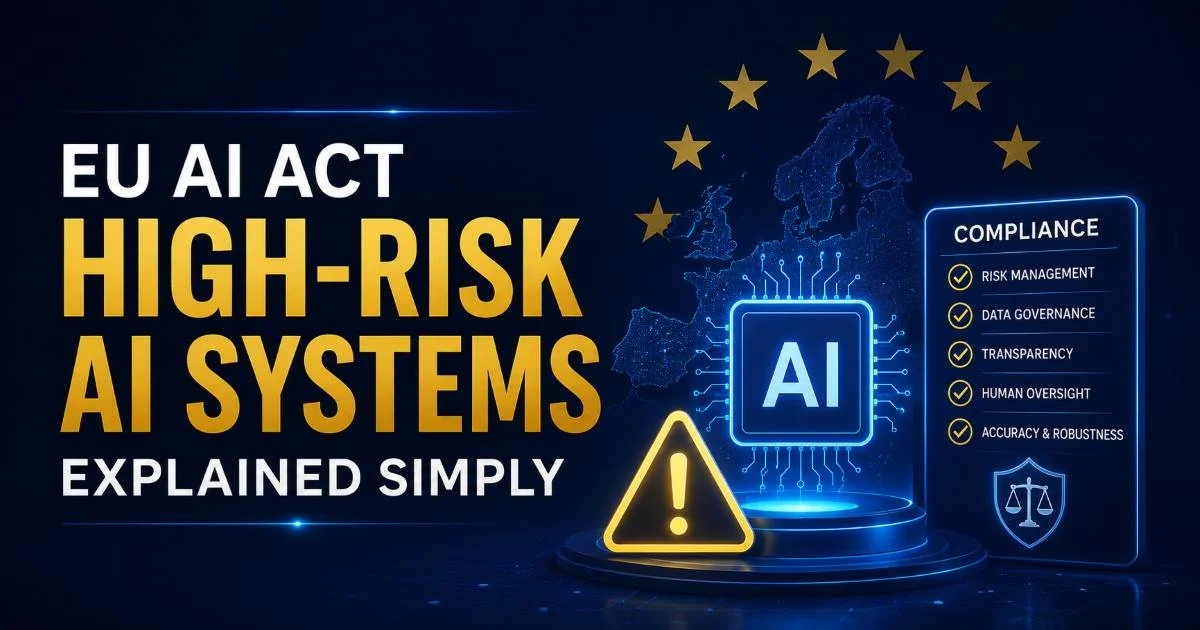
Next, perform a gap analysis against the Act's specific requirements for each risk tier. For high-risk systems, check whether you have a documented risk management system, data governance procedures, technical documentation meeting Annex IV specifications, record-keeping capabilities, transparency provisions, human oversight measures, and accuracy and robustness standards. Each of these is a distinct compliance requirement, and missing even one creates a regulatory gap that auditors will find.
Create a standardized internal template mapping each high-risk AI system against all Annex IV documentation requirements to spot gaps quickly.
After identifying gaps, prioritize remediation based on enforcement timelines and risk severity. Systems that might fall under prohibited categories need immediate attention. High-risk systems should follow, with a clear project plan targeting completion well before August 2026. Assign ownership for each remediation task to specific individuals, not teams, to prevent diffusion of responsibility. Track progress in a centralized compliance management tool with regular executive reporting.
Tools and Resources
Modern compliance workflows benefit enormously from purpose-built tools. Platforms like the one at aieuact.dev allow compliance officers to review AI risks, classify systems, check gaps against the Act, and receive clear compliance guidance in minutes rather than weeks. These tools translate the regulation's dense legal text into actionable steps tailored to your specific systems and organizational role. Consider also how AI companions and assistants, such as those reviewed by VisionVix, themselves need classification under the Act if they serve EU users.
Beyond tooling, invest in training. Your technical teams need to understand the Act's requirements in practical terms, not just legal summaries. Run workshops that walk engineers and data scientists through real classification scenarios. Build internal playbooks that translate regulatory text into engineering specifications. The organizations that succeed at EU AI Act compliance will be those where compliance knowledge is distributed across functions, not locked inside a legal team's inbox.

Frequently Asked Questions
?How do I classify an AI system under the EU AI Act risk tiers?
?Does EU AI Act compliance apply if my company is outside the EU?
?What are the fines for failing to comply with the EU AI Act?
?What's the biggest mistake companies make when starting EU AI Act compliance?
Final Thoughts
EU AI Act compliance is not a theoretical exercise or a distant concern. It is a present-day operational requirement with binding deadlines, substantial penalties, and real competitive implications. Compliance officers who act now, building inventories, performing risk assessments, and closing identified gaps, will position their organizations to operate confidently in the EU market.
The regulation rewards preparation and punishes procrastination. Treat your compliance program as you would any other critical business initiative: resource it properly, track it rigorously, and own it at the executive level.
Disclaimer: Portions of this content may have been generated using AI tools to enhance clarity and brevity. While reviewed by a human, independent verification is encouraged.